Thursday, 13 November 2014

Guerreros de Dios...God´s Warriors

Todos los aficionados a la historia comenzamos a serlo gracias a un tema que nos ha conmovido enormemente. A mí, en lo personal, me envolvió por completo la historia de la Tercera Cruzada en la cual se vieron las caras estos dos personajes, la encarnación pura de la dualidad perfecta de que se compone el arte de la guerra. 


Nos enseñan a menudo que la guerra es solamente miseria, desesperanza, muerte y violencia, mas no lo fue así en las palabras de los cronistas medievales que plasmaron la fascinante historia de la épica lucha entre el Rey de Inglaterra y el Sultán de Siria y Egipto, ambos adalid de sus respectivas religiones, hombres más influyentes de sus respectivos mundos y la representación de lo que debería ser el caballero perfecto.


James Reston Jr. nos envuelve con las sorprendentes anécdotas de la Tierra Santa medieval en la época en que Saladino arrebató la más sagrada de las ciudades cristianas a punta de batallas campales, alianzas con el enemigo, represión contra los fanáticos templarios y asedios colosales. Por otro lado, también nos introduce en su infancia y su juventud, sus logros militares y políticos antes de convertirse en el héroe más grande del Islam y sus campañas bélicas contra los enemigos de Mahoma.


Por otro lado, y con un sazón diferente, como el de un juglar campirano y trotamundos, nos cuenta la fascinante historia de Ricardo I de Inglaterra, que pasó a la eternidad con el pseudónimo "Corazón de León", en alusión a su arrojo, ferocidad y apremio por la batalla. Un personaje tan fascinante como contradictorio, la personificación de lo que un caballero debía ser en el siglo XII.


La obra está separada en la vida de Saladino, la de Ricardo, un itinerario sobre los preparativos para la Tercera Cruzada y el conflicto completo, con sus batallas y sus personajes y, principalmente, en un detallado mozaico de los choques titánicos de los dos guerreros más grandes de la Edad Media.


All the fans of the history we it begin to be thanks to a topic thanks to which it has upset us enormously. To me, in the personal thing, I was wrapped completely by the history of the Third Crusade in which there saw the faces these two personages, the pure embodiment of the perfect duality of which the art of the war consists.


They teach us often that the war is only a misery, despair, death and violence, any more there it was not like that in the words of the medieval chroniclers who captured the fascinating history of the epic struggle between the King of England and the Sultan of Syria and Egypt, both leader of its respective religions, more influential men of its respective worlds and the representation of what should be the perfect gentleman.


James Reston Jr wraps us with the surprising anecdotes of the medieval Holy Land in the epoch in which Saladino snatched the most sacred of the Christian cities from top of pitched battles, alliances with the enemy, repression against the fanatics templarios and colossal sieges. On the other hand, also it introduces us in its infancy and its youth, its military and political achievements before turning into the biggest hero of the Islam and its warlike campaigns against the Mahoma enemies.


On the other hand, and with a different ripeness, like that of a jongleur peasant and vagrant, tells us the fascinating history of Ricardo I of England, which went on to the eternity with the pseudonymic "Heart of León", in allusion to its fearlessness, ferocity and pressure for the battle. A personage as fascinating as contradictory, the personification of what a gentleman had to be in the XIIth century.


The work is separated in the Saladino life, that of Ricardo, an itinerary on the arrangements for the Third Crusade and the finished conflict, with its battles and its personages and, principally, in a detailed mozaico of the titanic shocks of the two biggest warriors of the Middle Age.

Wednesday, 12 November 2014

El sistema arquitectónico del Renacimiento y del Barroco. 1º PARTE -- The architectural system of the Renaissance and of the Baroque. 1º PART


Dicho estilo, entendiendo por estilo arquitectónico al conjunto de rasgos estructurales y decorativos característicos de un misma época, supone una ruptura radical del programa arquitectónico anterior. Esto no significa que un determinado estilo, en nuestro caso el Barroco, surja súbitamente, pues el proceso histórico es lento y continuado, y en él se han ido gestando, desarrollando y materializando los diferentes estilos arquitectónicos. 

Si se habla de una ruptura radical se hace referencia a nuevos planteamientos muy diferentes de los anteriores pero que, como ya se ha mencionado, son el resultado de una evolución íntimamente ligada a un cambio de mentalidad; y será precisamente este cambio de mentalidad, esta nueva idea subyacente, lo que permite diferenciar los diferentes estilos a la vez que percibir la unidad de cada uno de ellos. En el Barroco será la idea subyacente de desasosiego la que lo configura como unidad.

Es evidente que, al igual que ocurre en cualquier dimensión humana, el desarrollo choca con la tradición, y en el caso de la arquitectura, también lo hace con las exigencias prácticas, la naturaleza de los materiales y, sobre todo, con las contradicciones del propio sistema pues ,dado que ningún sistema cumple completamente sus conceptos específicos de interrelación de la diferentes partes, y dado que cada uno tiende a su autoexaltación, dicha exaltación propia acabará agudizando tanto las contradicciones que finalmente el sistema se desmoronará.

Centrándonos ya en el estilo que nos ocupa, hemos de decir que tanto Renacimiento como Barroco tienen un principio común, al menos desde el punto de vista arquitectónico: una nueva organización de los componentes (iniciada en el Renacimiento y llevada a su extremo en el Barroco), diferenciando unos de otros, perteneciendo todos a un mismo cuerpo arquitectónico, frente a la perfecta proporcionalidad vitruviana. Este nuevo ideal compositivo hace que estos dos estilos, a pesar de la utilización de los componentes clásicos, no sean copia de éstos.


Sin embargo, existen opiniones dispares al respecto, puesto que mientras muchos historiadores ven a Brunelleschi como el primer gran arquitecto del Renacimiento, otros lo ven como un simple copista de la Antigüedad. Ya se ha mencionado que el ideal compositivo  era la diferenciación de los componentes de un mismo cuerpo; pues bien, ésta será la contradicción principal del sistema, puesto que la desproporción entre partes romperá la unidad del cuerpo.

Con objeto de evitar esta contradicción inherente, diferentes autores han propuesto diferentes soluciones para resolver el problema de crear un cuerpo concatenado exaltando sus partes por separado, de hallar un compromiso entre los elementos verticales y horizontales. 

Algunos intentos para dar con la solución fueron la perforación de los muros, lo que ayuda a la unificación espacial entre interior y exterior (pero rompe la concatenación superficial), el uso de columnas salomónicas, el gran arco de San Andrea que ayuda a unificar la fachada con el cuerpo del edificio (a pesar de destrozar todo el frente) e incluso las cornisas de Santa Maria della Consolazione de Cola da Caprarola, en Todi, las cuales unen fuertemente las diversas partes. Pero quizá sí haya una solución común: configurar el edificio como una "T" invertida, es decir, realzar la planta baja contrastada con la incesante ascensión de los elementos en el centro.

Sin embargo, las contradicciones siguen estando patentes a lo largo de todo el periodo y siguen planteando los problemas en la resolución de os espacios tanto de uso civil como religiosos.

En el plano religioso, si bien en un principio se halló la solución de perfecto compromiso entre el eje vertical y el horizontal, como es la planta central con una gran cúpula culminando el eje vertical (esquema enormemente empleado en el Renacimiento), dicho esquema no era el mejor para el rito religioso, por lo que fue dando paso hacia el esquema basilical, más alargado. 

Además, el futuro de las iglesias estaría en el agrupamiento diferenciado de las partes, para poder así reconciliar el compromiso buscado entre horizontalidad y verticalidad con el buen servicio divino; diferenciación que llevará, conforme a la propia evolución de un sistema, a la desintegración. 

Un ejemplo de esta diferenciación lo constituye Santa Maria della Salute en Venecia, obra de Baldassare Longhena, cuyo espacio principal, de forma octogonal, y su coro son prácticamente independientes.

Este fenómeno también se produjo en la arquitectura civil de forma análoga, es decir, se pasó de las casas cuadradas a espacios rectangulares, como la mayor parte de las villas de Palladio.

Un paso más hacia la concatenación que había de estar presente en las obras barrocas lo constituye el hecho de la adaptación de los edificios al entorno, lo que dificulta en mayor grado todavía el conseguir una unidad total entre las partes y de cada una de las partes con el todo, constituyendo así otra de las contradicciones que llevan al desmoronamiento del sistema.

La necesidad de plasmar las ansiadas fuerzas vinculantes hizo olvidar en gran medida las propiedades de los materiales que se estaban tratando; así, se empleó la piedra, material rígido, cual materia orgánica blanda y flexible con la representación y utilización en las artes tectónicas del cuerpo humano y las formas animales, pues la materia viva encarna las fuerzas vitales omnipresentes en todas las cosas, tal como se creía en el Barroco. Ante esto comprobamos el choque entre la evolución que supuso el sistema barroco y la naturaleza de los materiales.

Una vez se descartó definitivamente la posibilidad de a anhelada unión barroca, las diferentes partes del edificio empiezan a separarse, conforme afirma Cornelius Gurlitt del torreón esquinero de San Carlo alle Quattro Fontane, de Borromini, el cual se halla ya en total desconexión con el cuerpo principal. También será característica de esta fragmentación la utilización de un pórtico débilmente unido, bastante frecuente hacia 1800. 

Aunque no sólo el exterior quedará fragmentado, sino también el interior conforme se puede apreciar claramente en una iglesia de Guarini: la Consolata, de Turín (1679). En dicha iglesia, la nave principal, de planta poligonal, el espacio oval del altar en el eje central y las dos capillas circulares que hay a ambos lados, tienen cada uno su propia cúpula.


The architectural system of the Renaissance and of the Baroque.


The above mentioned style, understanding for architectural style to the set of typical structural and decorative features of the same epoch, supposes a radical rupture of the previous architectural program. This nonmeans that a certain style, in our case the Baroque, arises suddenly, so the historical process is slow and continued, and in him they have been growing, developing and materializing the different architectural styles. 

If one speaks about a radical rupture one refers to new expositions very different from the previous ones but that, as it has already been mentioned, there are the result of an evolution intimately tied to a change of mentality; and it will be precisely this change of mentality, this new underlying idea, what allows to differentiate the different styles simultaneously that to perceive the unit of each of them. In the Baroque it will be the underlying idea of feeling of unease the one that forms it like unit.

It is clear that, as it happens in any human dimension, the development collides with the tradition, and in case of the architecture, also it does it with the practical requirements, the nature of the materials and, especially, with the contradictions of the proper system since, since no system fulfills completely its specific interrelation concepts of different parts, and since each one tends to its autoexaltation, the above mentioned proper exaltation will end up by sharpening so much the contradictions that finally the system will crumble.

Centring already on the style that occupies us, we have to say that both Renaissance and Baroque have a common beginning, at least from the architectural point of view: a new
organization of the components (initiated in the Renaissance and ride to its end in the Baroque), differing some of others, belonging all to the same architectural body, opposite to the perfect proportionality vitruviana. This new ideal compositivo does that these two styles, in spite of the use of the classic components, are not a copy of these.

Nevertheless, unlike opinions exist on this matter, since while many historians see Brunelleschi as the first big architect of the Renaissance, others see it like a simple copyist of the Antiquity. It has already been mentioned that the ideal compositivo was the differentiation of the components of the same body; well, this will be the main contradiction of the system, since the disparity between parts will break the unit of the body.

In order to avoid this inherent contradiction, different authors have proposed different solutions to solve the problem of creating a body concatenado exalting its parts separately, of finding a commitment between the vertical and horizontal elements. 


Some attempts to meet on the solution were the perforation of the walls, what helps to the spatial unification between interior and exterior (but it breaks the superficial linking), the column use salomónicas, the big arch of San Andrea who helps to unify the front with the body of the building (in spite of destroying the whole front) and even the cornices of Santa Maria della Consolazione of Tail gives Caprarola, in Todi, which join hard the diverse parts. But perhaps yes there is a common solution: to form the building as an inverted "T", that is to say, to heighten the first floor confirmed with the incessant ascension of the elements in the center.


Nevertheless, the contradictions keep on being clear along the whole period and spaces keep on raising the problems in the resolution of you so much of civil use as religious.


In the religious plane, although in the beginning the solution of perfect commitment was between the vertical axis and the horizontal one, as it is the central plant with a big dome reaching the vertical axis (scheme enormously used in the Renaissance), the above mentioned scheme was not the best for the religious rite, therefore it was passing towards the scheme basilical, more elongated. 

Also, the future of the churches would be in the grouping separated from the parts, for power like that to reconcile the commitment looked between horizontalidad and vertical position with the good divine service; differentiation that will go, in accordance with the proper evolution of a system, the disintegration. 

An example of this differentiation constitutes Santa Maria della his Salute in Venice, acts of Baldassare Longhena, whose main space, of form octogonal, and its choir they are practically independent.

This phenomenon also took place in the civil architecture of similar form, that is to say, it passed of the houses squared to rectangular spaces, like most of the towns of Palladio.

One more step towards the linking that had to be present in the baroque works constitutes it the fact of the adaptation of the buildings to the environment, what makes difficult in major grade still obtaining an entire unit between the parts and of each of the parts with everything, constituting this way other one of the contradictions that lead to the collapse of the system.

The need to capture the long-awaited binding forces made to forget to a great extent the properties of the materials that were talking each other; this way, the stone, rigid material was used, which soft and flexible organic matter with the representation and use in the tectonic arts of the human body and the animal forms, since the living matter personifies the omnipresent vital forces in all the things, as he believed in the Baroque. Before this we verify the shock between the evolution that supposed the baroque system and the nature of the materials.

Once the possibility discarded definitely of to longed baroque union, the different parts of the building begin separating, the same way as there affirms Cornelius Gurlitt of the corner turret of San Carlo alle Quattro Fontane, of Borromini, which is already in entire disconnection with the main body. Also the use of a porch will be typical of this fragmentation weakly close, quite frequently about 1800. 


Although not only the exterior will remain fragmented, but also the similar interior can be appreciated clearly in a Guarini church: the Consolata, of Turin (1679). In the above mentioned church, the main ship, of polygonal plant, the egg-shaped space of the altar in the essential part and two circular chapels that exist on both sides, have each one its own dome.


Thursday, 6 November 2014

INSTRUMENTOS POPULARES RUSOS --- RUSSIAN POPULAR INSTRUMENTS

El instrumento más viejo (el más antiguo, ya que el "kantele" mencionado en el "Kalevala" le debe su origen), es la guzla (deberíamos decir "los guslis"; en ruso esta palabra es plural). Consiste en una tabla de madera, con preferencia de abedul o plátano, sobre la que se tensan siete u ocho cuerdas afinadas en "dos" mayor sin grados cromáticos; con el tiempo, el número de cuerdas llega a setenta y seis. El tocador de "guzla" acompaña su canto mientras desgrana arpegios con sus dedos, uñas o un plectro.


A partir del siglo XII, importado de Bizancio, aparece un modelo de "gusli salterio", réplica perfecta del salterio. Bajo su influencia los "gulis" se perfeccionan: la madera es vaciada, se pulsan las cuerdas con macillos grandes: nace de este modo el "cymbalum" (utilizado acertadamente por Stravinski en su arcaico "Renard").

Otro instrumento de cuerda han hecho su aparición posteriormente: la "domra", la "balalaika", la "cobza", la "bandura", el "torban", luego la guitarra.

La domra era una especie de laúd importado de Asia por los kirguises, los mongoles y los persas. Al ser ser adoptada por el pueblo se convirtió en balalaika": en efecto, los"violeros" pueblerinos, al hallar dificultades para fabricar cajas de resonancia ovaladas, las sustituyeron con otras triangulares, al tiempo que reducian el número de cuerdas. La balalaika era el instrumento nórdico por excelencia, fabricado en madera de abeto. 

En el Mediodía, y sobre todo en Ucrania, se prefería la "cobza", usada por los polovitsianos y tártaro, y la "bandura"de importación occidental (cf. la "bandurria" española). Ambos instrumentos recordaban, por una parte, la guitarra española, y por la otra la "biwa" china; tenían de siete a veinticuatro cuerdas.

El torban, venido de Polonia, era una derivación de la tiorba pudiendo llegar hasta sesenta el número de sus cuerdas. A estos instrumentos añadiremos la "lira" ( una viella con tres cuerdas y once teclas) y el "gudok" (viola con tres cuerdas, de origen tártaro; se utilizaba un arco curvado; las dos primeras cuerdas emitían al unisono un sonido fijo que hacía de bajo continuo).

Los instrumentos de viento eran claramente los mismos que en Europa occidental: desde el siglo XIII existían orquestas en las que había hasta sesenta trompetas. Tenían además el caramillo, "jaleika" (especie de siringa utilizada en los entierros:["jalnik"- que ha dado lugar a "jalet", conpadecer- designando una tumba en viejo idioma eslavo] ), las flautas con cañas, las dobles faltas con cañas (diatónicas), la flauta de pan, la flauta bretona, la zurna, especie de oboe rudimentario, de origen tártaro.

Otros instrumentos de percusión: los "nacres", vasijas de tierra conocida recubiertas con pergamino, golpeadas con bastones o con bolas atadas a correas; las "cucharas" piezas de madera, después de cobre, imitando la forma de una gran cuchara, adornada con campanitas en sus extremos; se golpeaban unas contra otras.


The oldest instrument (the most ancient, since the "kantele" mentioned in the "Kalevala" owes its origin to him), is the guzla (we should say "the guslis"; in Russian this word is plural). It consists of a wooden table, with preference of birch or banana, on which there are tightened seven or eight ropes perfected in major "two" without chromatic grades; with the time, the number of ropes comes to seventy-six. The boudoir of "guzla" accompanies its singing while it shells arpeggioes with its fingers, fingernails or a plectrum.

Practically it is impossible to be able to execute a melody.

From the XIIth century imported from Byzantium, there appears a model of "gusli psalter", perfect reply of the psalter. Under its influence the "gulis" they are perfected: the wood is emptied, the ropes are touched with big hammers: there is born this way the "cymbalum" (used correctly by Stravinski in its archaic "Renard").
 
Another stringed instrument they have done its appearance later: the "domra", the "balalaika", the "cobza", the "bandura", the "torban", then the guitar.

The domra was a species of lute imported from Asia for the Kirghiz ones, the Mongols and the Persians. To be adopted by the people turned the being in balalaika": in effect, the "violeros" pueblerinos, on having found difficulties of making oval soundboxes, replaced them with triangular others, at the time that they were reducing the number of ropes. 

The balalaika was the excellent northerly instrument made of wood of fir. In the Midday, and especially in Ukraine, the "cobza" used by the polovitsianos was preferred and Tartar, and the "bandura" of western import (cf. the Spanish "bandurria"). Both instruments remembered, on one hand, the Spanish guitar, and for other one the Chinese "biwa"; they had from seven to twenty-four ropes.

The torban come from Poland, was a derivation of the tiorba being able to come up to sixty the number of its ropes. We will add the "lyre" to these instruments (a viella with three ropes and eleven keys) and the "gudok" (it violates with three ropes, of Tartar origin; a curved arch was used; the first two ropes were expressing to the unison a fixed sound that was doing of down continuously).

The wind instruments were clearly the same ones than in western Europe: from the XIIIth century there existed bands in which there was up to sixty trumpets. They had also the flageolet, "jaleika" (species of siringa used in the burials: ["jalnik" - that has given place to "jalet", conpadecer - designating a grave in old Slavonic language]), the flutes with canes, the double absences with (diatonic) canes, the flute of bread, the Breton flute, the zurna, species of rudimentary oboe, of Tartar origin.

Other percussion instruments: the "nacres", vessels of well-known ground covered with parchment, struck with canes or with balls tied to thongs; the "spoons" wooden pieces, after copper, imitating the form of a big spoon, adorned with campanitas in its ends; some were banging against others.

Saturday, 1 November 2014

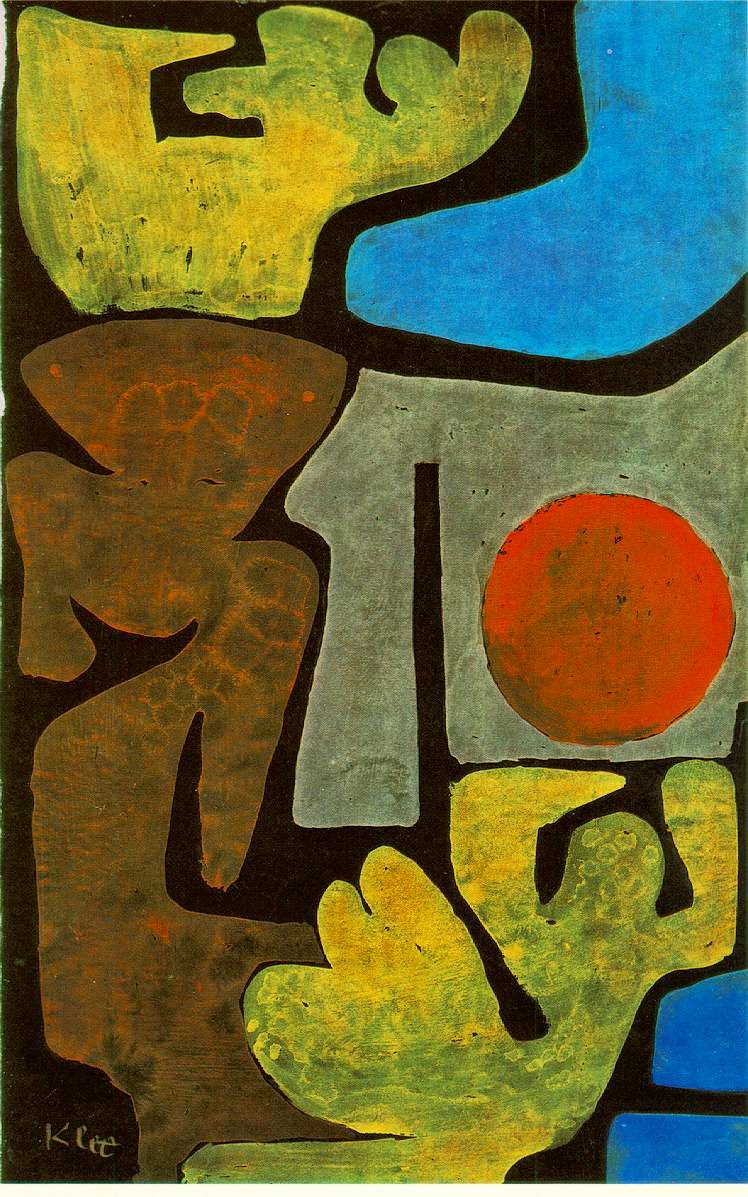
Klee.


Paul Klee era uno de los grandes maestros que establecieron la esencia y carácter de 
arte contemporáneo. Era un artista de una capacidad creativa y una variedad artística y profunda esto 
no había existido en países alemanes desde el tiempo de Albrecht Durer. 

Como Durer, Klee era 
predominantemente un delineante. El color entró en su arte tarde, y la parte principal de su trabajo era siempre dominado por el componente lineal. Su fantasía pareció inagotable - lindando con el grotesco, es gracioso en el anecdótico - pero siempre se arraigaba en su 
actitud, metafísica, hasta mística a la vida y arte. 

Klee también era un escritor excepcional 
en problemas formales y estéticos y un profesor distinguido. A él debemos un poco 
la mayoría de las declaraciones hermosas de arte contemporáneo.

Paul Klee was one of the great masters who established the essence and character of 
modern art. He was an artist of a creative capacity and an artistic range and depth that 
had not existed in German countries since Albrecht Durer's time. 

Like Durer, Klee was 
predominantly a draftsman. Color entered his art late, and the main body of his work was 
always dominated by the linear component. His fantasy seemed inexhaustible--the demonic 
bordering on the grotesque, the humorous on the anecdotal--but it was always rooted in his 
metaphysical, even mystical, attitude to life and art. 

Klee was also an outstanding writer 
on formal and esthetic problems and a distinguished teacher. To him we owe some of the 
most beautiful statements on modern art


Marcel Duchamp


Art Black Side